
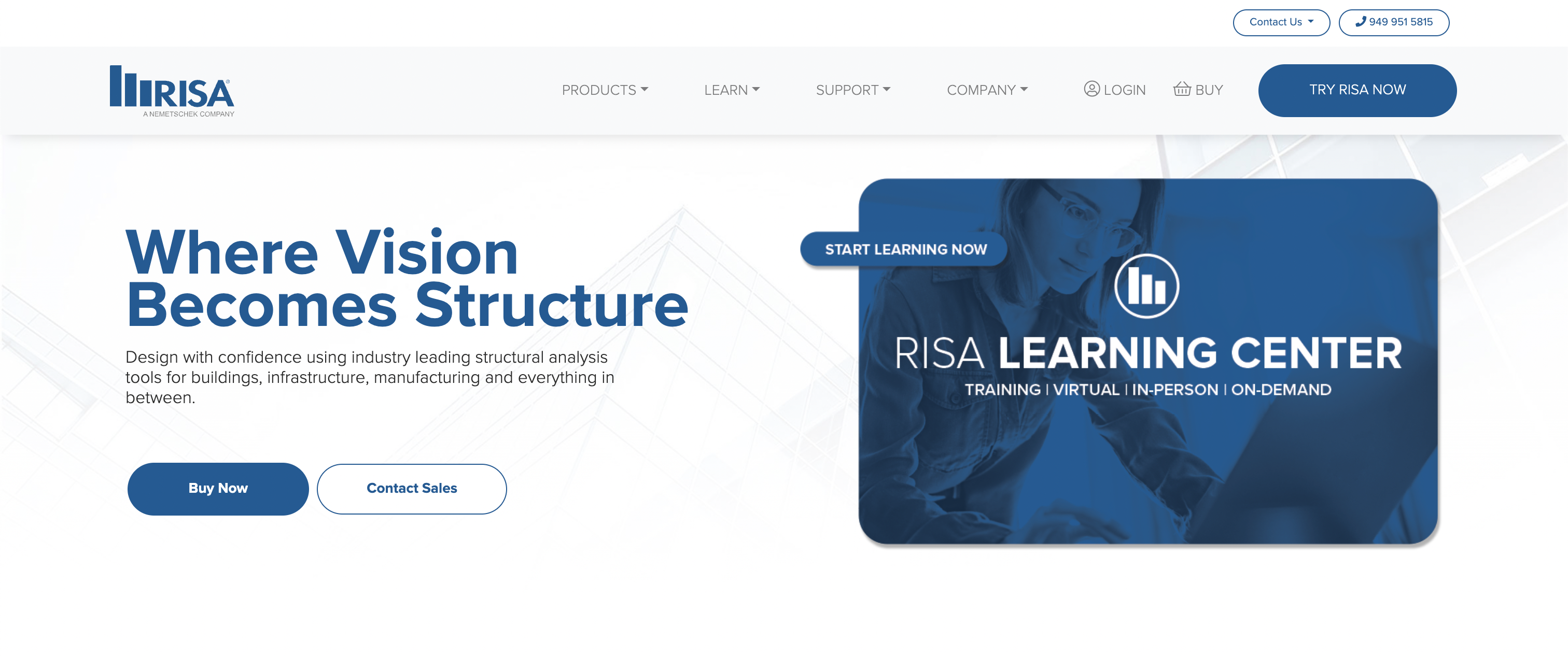
At a Glance
- 5 years - long-term retainer from rescue tasks to proactive partnership
- Zero crashes - eliminated site instability through infrastructure fixes and proper hosting
- Team of 4 - led 2 developers and 1 designer
- Section-by-section redesign - homepage, product pages, and article pages transformed
- YouTube + HubSpot - intelligent integrations eliminating manual content work
- Stable releases - from risky manual deployments to predictable CI/CD with rollback
Five years with RISA, a structural engineering software company, taught me how to systematically transform a website from a rigid, high-maintenance burden into a flexible, self-sustaining content platform. I started with urgent rescue tasks: fixing poorly configured Amazon hosting that caused periodic crashes, addressing hardcoded pages that required developer involvement for simple content changes, and establishing basic reliability. The site went from unpredictable downtime to zero crashes. Over time, the engagement evolved into a proactive partnership focused on removing workflow friction for their marketing and content teams.
As Lead Web Engineer and Client Manager, I managed a team of 2 developers and 1 designer, owned client communication, and drove roadmap and sprint planning. The relationship evolved from reactive fixes to a structured retainer with quarterly planning and continuous improvement.
From Rigid to Flexible
The core transformation was making the website genuinely manageable by non-technical staff.
The Problem: RISA’s website had grown organically over years, resulting in pages with hardcoded content or rigid field structures. Simple updates, like changing a section heading or adding a new content block, required developer time. The marketing team was bottlenecked by technical constraints that should not have existed.
What I Built:
- Redesigned page structures to use flexible, reusable content components
- Created a component library that marketing could assemble without developer involvement
- Transformed homepage, product pages, and article pages section by section
- Each redesign prioritized flexibility: components that could be reordered, added, or removed through the CMS
The result: content updates that previously required developer tickets became self-service tasks for the marketing team.
Intelligent YouTube Integration
RISA maintains an active YouTube channel with educational content for structural engineers. Previously, displaying these videos on the website meant manual work: copying each video’s title, thumbnail, URL, and description into the CMS, then repeating the process every time new content was published.
What I Built:
- Automated video syndication that pulls from RISA’s YouTube channel
- Category-based filtering so users can find relevant content quickly
- Semantic search allowing users to search videos by topic, not just title
- Automatic thumbnail and metadata synchronization
The marketing team stopped spending time on manual video management entirely. New YouTube content appears on the website automatically, properly categorized and searchable.
HubSpot Blog Integration
When RISA migrated their blog to HubSpot, they faced a common problem: blog content lived in one system, but needed to appear on the main website. Without integration, this meant manual copying or accepting that the website would always show outdated content.
What I Built:
- Automatic synchronization of HubSpot blog posts to the Craft CMS website
- Consistent styling and formatting across both platforms
- Real-time updates: new posts appear on the website without any manual intervention
This removed the friction of maintaining content in two places and ensured the website always reflected current marketing content.
Infrastructure and Reliability
When I started, RISA’s hosting and deployment situation created unnecessary risk and friction.
Hosting: The website ran on a custom Amazon EC2 configuration that was not properly optimized. I worked to stabilize the environment, improve performance, and establish proper monitoring.
Deployment Pipeline: Deployments were manual with no version control integration and no ability to rollback if something went wrong. Every release was a risk. I established a proper CI/CD pipeline using DeployHQ, connected to Git, with staging environments and safe rollback capability.
The result: deployments became predictable and safe rather than stressful events. Releases that previously caused anxiety now happen routinely without incident.
5-Year Journey
The engagement evolved significantly over five years:
Initial Phase: Urgent fixes and stabilization. Addressing hosting issues, fixing broken functionality, and establishing basic reliability.
Growth Phase: Section-by-section redesign. Systematically transforming rigid pages into flexible, component-based structures.
Maturity Phase: Intelligent integrations and automation. YouTube and HubSpot integrations that eliminated ongoing manual work.
Ongoing: Continuous improvements, security updates, and proactive maintenance that kept the website healthy and the marketing team unblocked.
Technologies Used
CMS & Backend: Craft CMS, PHP, Yii2, MySQL
Frontend: Twig, HTML/CSS, Javascript
Integrations: HubSpot, YouTube API, API
Infrastructure: AWS EC2, Cloudflare, DeployHQ, Git
Testing & Quality: PHPUnit
Project Management: Trello
Interested in Similar Work?
If you're looking for similar solutions or want to discuss your project, I'd be happy to help.
Implemented solutions:
- Automatic Data Synchronization
- Flexible Content Management
- Marketing Content Components
- Website Redesign Implementation
- Website Performance Optimization
- Website Core & Stability
- Website Technical SEO Optimization
- File Storage Integration
- Website Security Optimization
- Development and Deployment Pipeline